
Your chatbot knows the customer before it has to ask
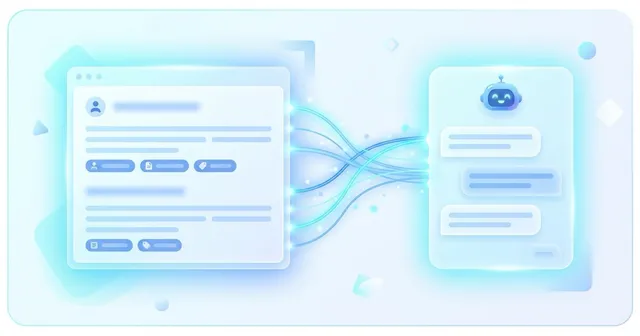
The embedding page passes context from your CRM, customer portal, or logged-in area to the chat: name, contract, case number. The AI answers personally and fills API calls with the right data automatically.
- Context via HTML attribute or JavaScript event
- AI uses the data in answers and API calls
- No asking for customer or case numbers
- Processed per request, not stored as a record
No more “What was your customer number again?”
A chatbot inside a logged-in area that doesn't know the customer feels out of place. Your system already knows who is sitting there and which case is open. Session context data hands that knowledge to the chat: as an attribute at embed time or via JavaScript at runtime. The AI greets the customer by name, knows contract and case, and fetches matching data through API connectors.
Features
What session context data can do
Two ways to pass data
A simple attribute format (Customer=Acme Ltd;CustomerID=1023) with no JSON knowledge required, or a JavaScript event for dynamic updates after login and case switches.
Straight into the AI context
The values are available to the AI on every answer. It addresses the customer by name and refers to the specific contract instead of staying generic.
Automatic API calls
API connectors and MCP tools receive matching arguments from the context: case number, customer ID, or a session token your backend verifies.
Login token instead of plain identity
Pass a short-lived token for logged-in users. Your backend validates it on the API call and only then returns personal data – forged context leads nowhere.
Not stored
Context data applies per request and is not stored as its own record. What your CRM knows stays in your CRM.
For both widgets
The floating widget and the inline widget accept context data alike – even combined on the same page.
Use Cases
Use cases
CRM and business applications
The chat runs inside a closed system: staff see case, contract, and customer – so does the AI. Answers match the open case without anyone retyping IDs.
Customer portals with login
Logged-in customers get personal answers. Via a session token, the AI fetches order status, contracts, or invoices from your backend – validated server-side.
Support with case context
Ticket or case numbers travel into the chat automatically. The AI answers questions about the specific case and hands over to the right contact when needed.
Brokers and advisory work
Agents handle many clients in parallel. The chat knows the currently opened client including contract and case – without a single follow-up question.
FAQ
Frequently asked questions
Either as the HTML attribute context-data in the simple format Customer=Acme Ltd;CustomerID=1023 or as JSON, or at runtime via the JavaScript event webchatagent:context. The event replaces the full context and suits logins and case switches.
Connect chat and system
Paste the widget snippet, pass context and test the integration.