
White-Label AI Phone Platform for Agencies: Voice Agents Under Your Brand
Your clients are losing calls while their teams are busy, offline or already on the phone. A white-label AI phone platform lets you solve that problem under your own name: one branded control center, separate phone assistants for every client and recurring revenue that belongs to your agency.

Agencies have sold websites, hosting, SEO and chatbots for years. The next logical managed service is the business phone: not a replacement telephone system, but an AI assistant that answers routine calls, books appointments, captures requests and hands complex conversations to a human. White-label makes that service yours instead of turning your agency into a referral channel for somebody else's brand.
What is a white-label AI phone platform?
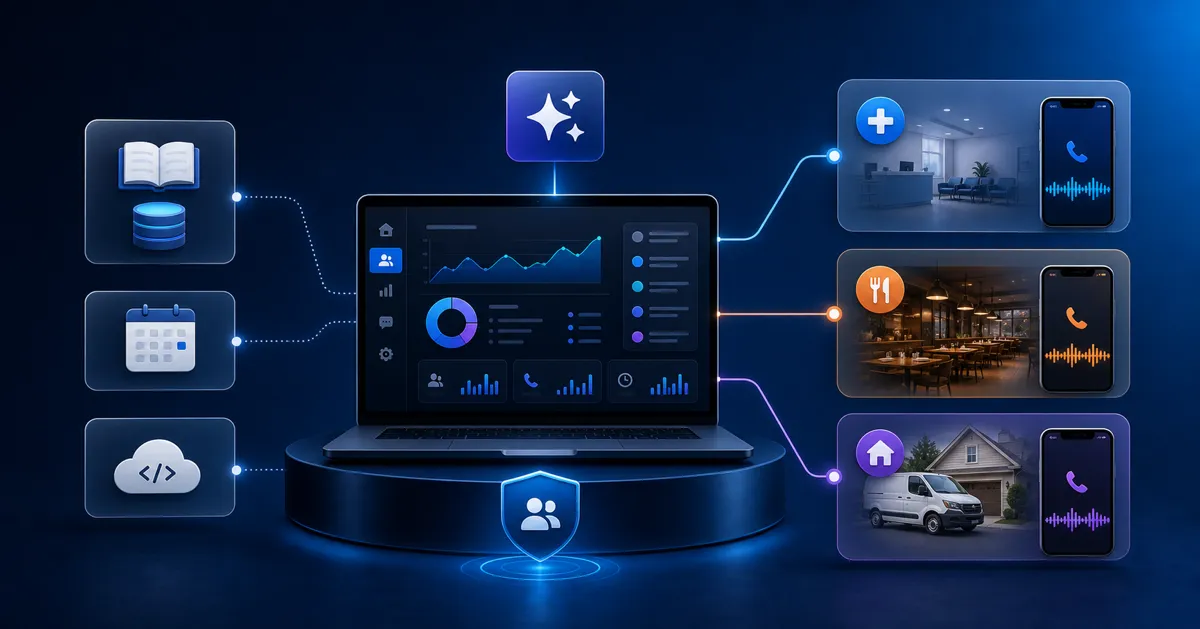
A white-label AI phone platform is a multi-client system that lets an agency create, configure and operate AI phone assistants under its own brand. Each client gets its own assistant, knowledge, number, greeting and routing rules. The agency manages the whole portfolio from one platform and decides what the client sees, what the service is called and what it costs.
This is different from simply joining an affiliate program. With an affiliate link, your client signs up with the vendor and the vendor owns the customer relationship. With white-label, the dashboard, domain and service experience carry your identity. You package the technology with setup, training, integrations and ongoing optimization, then invoice the client at your price.
Why phone AI is a strong agency service
A chatbot improves a website. A phone assistant reaches deeper into daily operations: the number is printed on the website, appears in Google Business Profiles and rings whenever a customer wants an immediate answer. That makes the service visible, measurable and difficult to replace once it works.
- The pain is obvious: missed calls, long hold times and repetitive interruptions are easy for a client to recognize.
- The result is measurable: answered calls, booked appointments, captured leads, transfers and off-hours conversations can all be tracked.
- The service is recurring: phone numbers, minutes, knowledge maintenance and routing rules create an ongoing relationship.
- The upsell is natural: agencies already manage the website, content, campaigns or chatbot that provide the assistant's knowledge.
- The value exceeds pure cost savings: a call answered at 8 p.m. can become a booking or lead that would otherwise go to a competitor.
How the multi-client model works
- Your agency runs the platform. The administration area uses your logo, colors and domain.
- You create a workspace for each client. Access, bots, phone numbers and usage can be assigned without mixing customer data.
- Each assistant learns the right business. Website pages, PDFs, internal documents and connected systems form its knowledge base.
- The phone channel is configured per assistant. You define the greeting, language, voice, availability, call duration and handover rules.
- Calls become structured work. The assistant answers questions, books appointments, captures contact details or routes the caller with context.
- You monitor and improve. Call histories and unresolved questions show where knowledge or instructions need work.
The useful part of an omnichannel platform is reuse. The same business knowledge that powers web chat can also support WhatsApp and phone conversations. Your agency maintains the answer once instead of creating three disconnected systems.
What agencies should be able to offer
A branded customer experience
White-label is more than hiding a footer. Clients should log in through your domain, see your visual identity and receive a phone experience designed by your agency. On the call itself, branding comes from the greeting, voice, tone and process rather than a logo.
Separate assistants with shared agency capacity
Every client needs an isolated assistant and its own knowledge. At the agency level, shared package capacity keeps utilization efficient: a quiet client does not leave an entirely separate subscription unused while another client has a busy week. Phone minutes and additional numbers can be expanded as the portfolio grows.
Real actions, not just spoken FAQs
A useful voice agent must do more than recite opening hours. Calendar booking, structured lead capture, API connectors and a clean human handover turn a conversation into a completed process. The exact permissions should stay narrow: the assistant may book an available slot, for example, but should not invent exceptions or make risky commitments.
Multilingual conversations
Hotels, medical practices, property managers and online shops regularly receive calls in more than one language. A multilingual assistant can keep the same knowledge and business rules while responding in the caller's language, without a keypad menu or separate line for every market.
Current white-label and voice packages
WebChatAgent separates the white-label platform package from the voice tier. That lets an agency scale the number of client assistants and the actual call capacity independently. The following voice prices are monthly net prices as of July 2026:
| Voice tier | Price / month | Included minutes | Concurrent calls | Phone numbers |
|---|---|---|---|---|
| Basic | €39 | 100 | 2 | 1 |
| Pro | €79 | 1,000 | 3 | 1 |
| Agency | €239 | 3,000 | 10 | 3 |
Extra packs add 100 minutes for €15 per month, and additional phone numbers cost €7 per month. The underlying white-label platform starts at €29 per month and scales by chatbot slots, messages and content capacity. This modular structure matters because an agency with ten client bots does not necessarily have ten high-volume phone clients on day one.
A realistic margin example
Suppose an agency uses the Growth white-label package and the Agency voice tier for five phone clients. It adds two numbers so each client has a dedicated line:
- Platform package: €199 per month
- Agency voice tier: €239 per month
- Two additional numbers: €14 per month
- Total platform cost: €452 per month before VAT and any extra usage
If the agency sells five managed phone assistants at €249 each, monthly revenue is €1,245. The gross spread is €793 before its own support, sales and tax costs. Five setup projects at €450 add €2,250 in one-time revenue. These are example resale prices, not a promise of profit; your real margin depends on call volume, setup effort and the service level you include.
The strongest offer is rarely “AI minutes.” Package the outcome instead: missed-call coverage, appointment booking, lead intake, monthly optimization and a defined number of included minutes. That is easier for a client to understand and harder to compare with a raw software subscription.
Three packages an agency can sell
- After-hours receptionist: answers when the team is closed, handles standard questions and records a qualified callback request.
- Appointment assistant: answers routine questions, checks a connected calendar and books, reschedules or cancels appointments.
- Managed AI front desk: covers business hours and peaks, connects to business data, transfers urgent calls and includes monthly review and optimization.
Add a clear fair-use or overage rule to every package. Clients should know how many minutes and numbers are included, what happens when the limit is reached and which custom integrations cost extra.
The seven-step client rollout
- Audit the calls: collect the top reasons people call, current volumes, busy periods and missed-call rate.
- Choose a narrow first job: start with FAQs, callback intake or appointments instead of trying to automate every conversation.
- Build the knowledge: clean up opening hours, prices, service areas, policies and the answers staff already give.
- Define guardrails: specify what the assistant may answer, when it must ask a follow-up question and when it must transfer.
- Configure the line: assign a number or forwarding route, greeting, language, voice and availability.
- Test real scenarios: use short callers, noisy callers, vague requests, complaints and questions outside the knowledge base.
- Launch and review weekly: inspect unresolved calls, update the knowledge and expand the scope only when the first process is stable.
Trust, GDPR and human handover
Voice automation needs more trust than a web widget because callers cannot inspect the interface before they start speaking. Tell callers clearly that they are talking to an AI assistant. Collect only the information needed for the task, define retention rules and provide a straightforward path to a human. If calls are recorded, check the consent and notice requirements that apply in the client's country and use case.
For European clients, also check where data is hosted, whether a data processing agreement is available, which subprocessors handle telephony and speech, and how data is separated between agency customers. EU hosting and GDPR-oriented administration make the sales conversation easier, but they do not replace a clean process on the agency side.
What to check before choosing a platform
- Can the vendor's branding be removed from the admin area and client experience?
- Can you use your own domain, logo, colors and client logins?
- Are customer workspaces, knowledge and call data properly separated?
- Can each client have their own number, greeting, voice and transfer rules?
- Are minutes, numbers and concurrent calls visible and expandable?
- Can the assistant book appointments, call APIs and hand off with context?
- Does one knowledge base support chat, WhatsApp and phone?
- Are EU hosting, a DPA, deletion controls and role-based access available?
- Can you export usage and show clients the outcome of the service?
When a white-label phone assistant is not the right fit
Do not automate calls that depend mainly on empathy, negotiation or specialist judgment. Complex complaints, legal commitments, emergencies and sensitive diagnoses need a human-led process. A good phone platform supports fast recognition and handover instead of forcing every caller through an automation target.
The bottom line
A white-label AI phone platform turns a common client problem into a repeatable agency product. You keep the brand and customer relationship, each client gets a purpose-built assistant, and one central platform gives you the operational leverage to manage the portfolio profitably.
Start with one client and one measurable job. Answer every after-hours call, capture every lead or book every standard appointment. Once that result is visible, the phone assistant stops sounding like an AI experiment and starts looking like infrastructure the client wants to keep.
Explore the white-label platform for agencies, learn how the AI phone assistant works, or read the honest analysis of how much phone AI really takes off a service team.
Launch AI phone assistants under your brand
Manage separate voice agents for your clients from one branded platform, with shared capacity, phone numbers, integrations and clean human handover.