
AI Phone Assistant for Customer Service: How Much Does It Really Help?
The phone is the most expensive support channel, and the one where missed contacts hurt the most. An AI phone assistant promises to answer every call. This article does the honest math: how many calls it truly handles alone, where a human still has to step in, and why the biggest win is not the minutes you save.
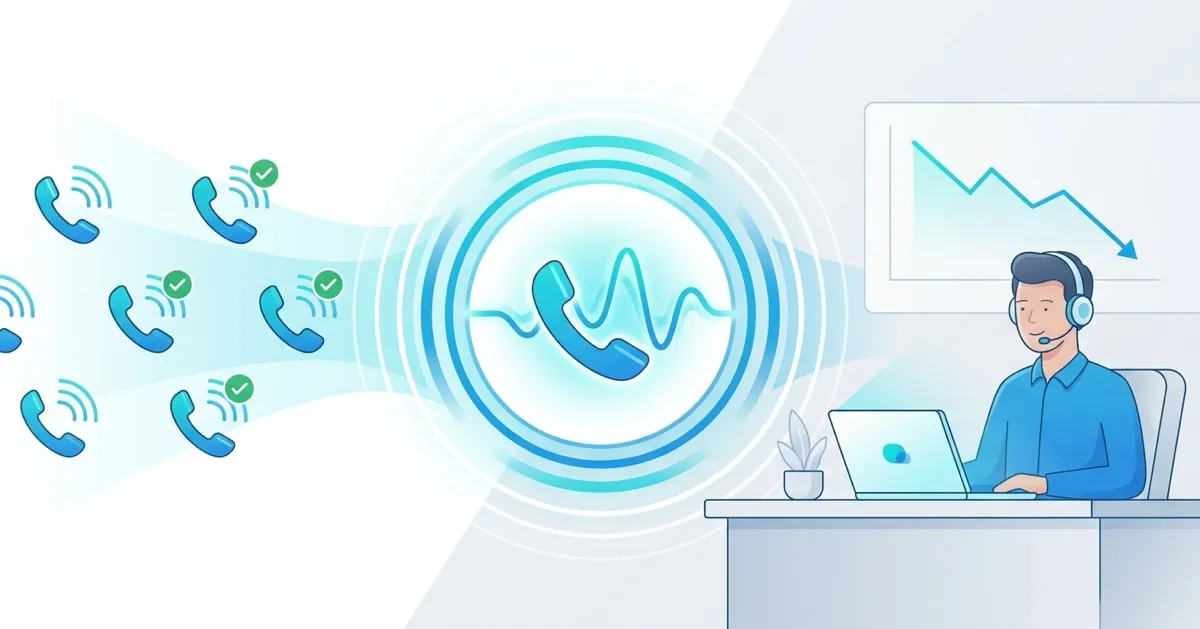
An AI phone assistant answers calls in real time, understands the request and replies from your knowledge base. No touch-tone menu, no "press 1 for sales," just a conversation. Vendors love to promise full automation. The interesting question is a different one: how much real work does an assistant like this take off your team, and where does the value actually sit? Let us work it out.
Why the phone is the most expensive channel
On the phone there is no parallelism. A chat agent runs three to five conversations at once; a phone agent runs exactly one. Every call ties up a person for its full length, plus wrap-up. That makes voice far more expensive per contact than chat.
Worse than the cost are the missed calls. Lunch break, after hours, the weekend, a sudden rush: the phone rings out. Industry-wide, 20 to 30 percent of calls are lost. And a missed call in service or sales is not a deferred ticket, it is often a lost customer who dials your competitor next.
The honest figure: how many calls does it handle alone?
This needs two metrics, not one. The first is the answer rate: how many calls get picked up at all? An AI assistant lifts it to practically 100 percent, because it never takes a lunch break and answers on the first ring. The second is the self-resolution rate: how many calls does it complete without a human?
On that second number, the same honesty applies as in chat. Not 90 percent. A well-configured phone assistant realistically resolves 30 to 50 percent of calls entirely on its own. On the phone the figure tends toward the lower end, because callers phrase things more spontaneously, wander off topic faster, and ask for a human sooner when unsure. That is not a flaw, it is the nature of the channel.
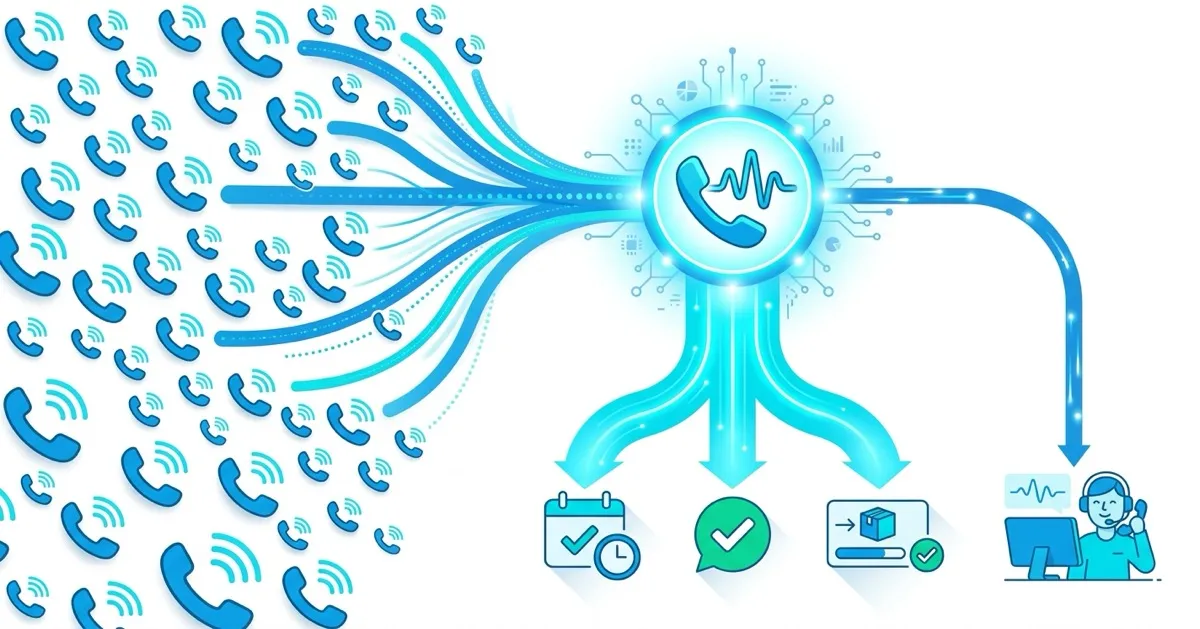
Where it genuinely takes work off your team
The relief is real for anything that is a clear answer or a clean process:
- Standard information: Opening hours, directions, prices, availability. In seconds, no hold music.
- Status requests: "Where is my delivery?", "Is my appointment still on?" The assistant pulls the answer from your data.
- Appointment booking: Create, reschedule or cancel, straight into the calendar. One of the strongest voice use cases.
- Callback requests: Captured cleanly with name, number and reason, so the callback is targeted.
- Nights, weekends, lunch breaks: Calls that used to be lost now get answered and usually resolved on the spot.
- Load spikes: Fifty simultaneous calls produce no busy signal. A team cannot do that.
Where a human has to step in
And the other half of the honesty: some calls are hurt by an automated conversation. Force the self-resolution rate and you annoy exactly the customers you want to keep.
- Complaints and escalation: An angry caller wants a human immediately. Rightly so.
- Negotiation and goodwill: Decisions that need judgment belong to someone who has it.
- Complex diagnosis: Layered technical problems that need follow-up questions and a feel for the situation.
- Legally binding matters: Commitments with liability risk. An assistant that answers too boldly here is a problem.
The difference between a good phone assistant and an annoying one is not the self-resolution rate. It is how quickly it recognizes it should hand off, and how cleanly the caller arrives at the right human with context.
The real lever: no more missed calls
Here is the point the minute math alone misses. With voice, the pure payroll saving is more modest than in chat, because talk minutes cost more than a few lines of text. The big win sits elsewhere: with the calls nobody used to answer.
Every call that used to ring out is now a contact. An appointment request that would have gone to a competitor. An order that would not have happened. A question resolved before the customer hangs up in frustration. That is revenue, not just saved cost, and for most businesses it outweighs the payroll time you free up.
What it costs, measured in minutes
A phone assistant is billed per talk minute, not per message. That is the key difference from the chat calculation. Three line items belong in the math:
- Talk minutes: Available as an add-on from the Basic plan. The entry voice tier is €39 net per month with 100 talk minutes; larger tiers have different allowances and prices.
- Phone number: A dedicated number the assistant answers on, or your existing one via forwarding.
- Setup and maintenance: The same knowledge base as your chatbot, plus the greeting and routing rules. The effort depends on source quality, integrations, call flows, and testing.
An illustrative worked example
The following inputs demonstrate the calculation method; they are not WebChatAgent customer results or a forecast. Replace every assumption with your own baseline and pilot data. Suppose a business has 800 calls a month, averaging 3.5 minutes each, and assumes that 20 percent are currently missed.
- If the pilot reached a 100 percent answer rate and a 40 percent self-resolution rate, that would equal around 320 calls resolved without a transfer.
- On the payroll side that is 320 calls times about 5 minutes including wrap-up, roughly 27 hours a month. At 25 euros fully loaded per hour, about 670 euros of relief.
- Against that stand the minute costs for the call volume, roughly 200 to 240 euros a month depending on the package.
- Under these assumptions, the direct difference would be roughly 400 euros per month.
- If 160 previously missed calls had an €80 average order value and a 15 percent close rate, the modeled revenue opportunity would be around €1,900 per month.
This is arithmetic, not a promised outcome. The pilot must establish the actual answer rate, self-resolution rate, cost, and conversion effect.
How to tell whether it actually helps
Measure the right numbers or you will talk yourself into or out of success. These five are enough:
- Answer rate: Share of calls picked up. Record the current baseline and compare it with the pilot.
- Self-resolution rate: Share of calls handled without a transfer. Shows how much routine actually sticks.
- Wait time: Seconds on hold. Should trend toward zero.
- Off-hours calls: How much runs at night and on weekends? Pure added capacity that did not exist before.
- Handover quality: Do transferred callers reach the right human with context, or do they have to repeat everything?
The bottom line
An AI phone assistant can take work off your team, but the value sits differently than in chat. Measure how many calls it resolves, captures, or transfers correctly, including outside business hours.
The goal is not to force every call through automation. Configure the assistant to handle documented routine requests and pass the rest to humans, then verify the result in call data.
See how the AI phone assistant works and which languages it speaks on the product page. Or start for free and measure the answer and self-resolution rates against your real calls.
Stop letting calls ring out
The same AI assistant that answers your chat also takes calls in real time: clear up questions, book appointments, hand off when needed. Try it free.