
Why Not All Chatbots Are Equal: What Most Providers Won't Tell You
Most chatbots are just a chat widget with an LLM behind it. They scrape your website, throw the text into AI, and hope for good answers. A real AI agent system is fundamentally different, in data processing, capabilities, and business value.
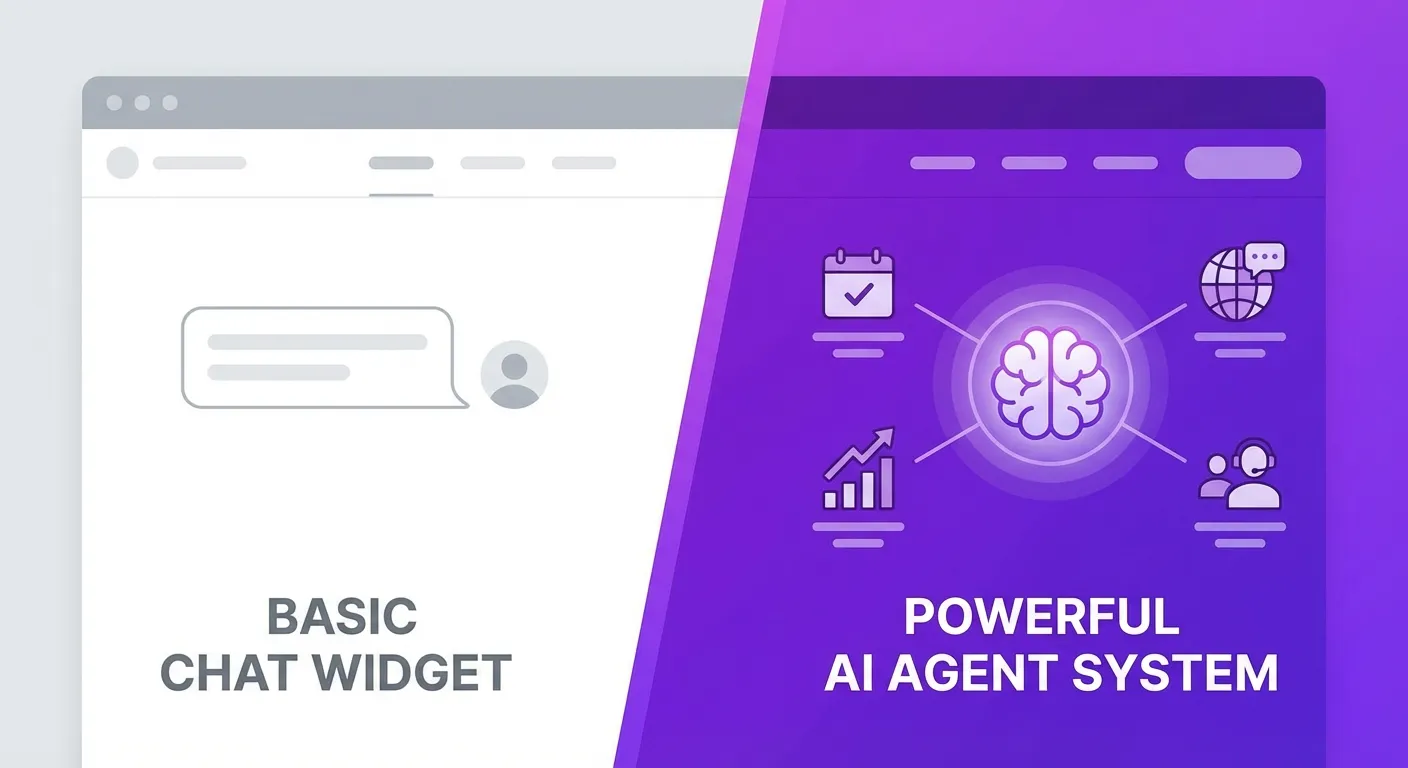
Chat Widget vs. AI Agent
The Uncomfortable Truth About Most Chatbots
The chatbot market is booming. Hundreds of providers promise "AI-powered customer support," and the numbers are staggering: the global chatbot market is projected to reach over $15 billion by 2028. Every SaaS company, agency, and freelance developer seems to be launching their own chatbot product. LinkedIn is full of ads claiming you can "automate 90% of customer support" with their tool. It sounds too good to be true, and for most products, it is.
Here is what they don't tell you: the vast majority of these "AI chatbots" are architecturally identical. The typical setup looks like this: scrape a website, dump the extracted text into an LLM's context window, wrap it in a chat widget, and call it an "AI agent." Some add a logo customizer and a few color options, charge $49/month, and call it a day. From the outside, these products look polished. But under the hood, they are all running the same basic pipeline, and that pipeline has fundamental limitations.
This approach works fine for the simplest of questions. "What are your opening hours?", sure, the bot can probably find that on your homepage. "Where are you located?", no problem, that's usually in the footer. But the moment you need real business value, accurate product recommendations based on specific criteria, appointment scheduling that actually checks availability, lead qualification with structured data capture, or integration with your existing systems, the whole thing falls apart spectacularly.
The fundamental issue is this: there is a massive gap between a "chat widget with AI" and a "true AI agent system." Most providers occupy the first category but market themselves as the second. This article will show you exactly what that gap looks like, give you 7 critical questions to unmask any provider's real capabilities, and provide a complete buyer's checklist so you can evaluate any chatbot solution objectively, whether it's ours or someone else's.
Chat Widget vs. AI Agent: The Architecture Gap
The difference between a basic chatbot and a real AI agent isn't cosmetic, it's architectural. It's the difference between a static brochure and a dynamic web application. They might look similar on the surface, but what happens behind the scenes determines everything: accuracy, reliability, capabilities, and ultimately, business value. Let's break down the three critical areas where the architecture gap becomes obvious.
Surface Scraping vs. Source-Backed Search
Basic chatbots use the simplest possible approach to data processing: they crawl your website, extract the raw HTML text, and stuff it directly into the LLM's context window. This sounds reasonable until you understand the problems. First, context windows are limited, even the largest models cap out at a certain number of tokens. If your website has hundreds of pages, the bot either gets only a fraction of your content or the data is so compressed that critical details are lost. Second, the data is completely unstructured. Product specs sit next to blog comments, pricing tables are mixed with footer navigation text, and FAQ answers lose their connection to the original questions.
When a customer asks a specific question, say, "What's the difference between your Professional and Enterprise plans?", the bot searches through this unstructured text soup and often pulls the wrong passage. Maybe it finds a blog post from 2023 that mentioned old pricing, or it grabs a partial sentence from your comparison table that's missing crucial context. The result: wrong answers that look confident. And confident wrong answers are far more dangerous than no answer at all.
A purpose-built AI agent such as WebChatAgent divides your content into meaningful passages and searches those passages for the best match to each question. The technical term is Retrieval-Augmented Generation (RAG). Only the relevant source passages are then supplied to the AI model as evidence, so the answer stays connected to your published information instead of relying on an unstructured text dump.
Context Understanding, Stateless vs. Stateful
Basic chatbots process each message in isolation, or at best, with minimal context from the current conversation. This creates an experience that feels robotic and frustrating. Consider this common scenario: a visitor asks, "What does the Pro plan include?" The bot gives a decent answer. Then the visitor follows up with, "How much does it cost?" A basic bot has no idea what "it" refers to. It might respond with a generic pricing overview, ask "What do you mean?", or worse, give pricing for a completely different product.
A true AI agent maintains full conversation history within a session. It understands pronoun references ("it," "that," "the first one"), follow-up questions ("What about annual billing?"), contextual shifts ("Actually, I'm more interested in the Enterprise plan"), and even implicit context from visitor behavior. Session management that feels like talking to a knowledgeable human, where each message builds on the previous ones, rather than restarting from zero with every interaction. This is not a nice-to-have feature. It's the difference between a conversation and a series of disconnected questions.
Capabilities, Answer Bot vs. Action Agent
This is where the gap becomes a canyon. Basic chatbots can do exactly one thing: answer questions based on text. That's it. If a customer wants to book an appointment, the bot says "Please call us at (555) 123-4567." If they want to check their order status, the bot says "Please check your email for tracking information." If they want a quote, the bot says "Please fill out our contact form." Every single real action requires the customer to leave the chat and do it manually somewhere else. The chatbot hasn't automated anything, it has just added an extra step.
A true AI agent can actually do things. It can book appointments directly by checking Google Calendar for real-time availability and confirming the booking within the chat. It can capture and qualify leads through structured forms embedded in the conversation flow. It can call external APIs to fetch real-time data, order status, inventory levels, dynamic pricing. It can trigger workflows via Zapier or n8n to create CRM entries, send notifications, or update databases. It can escalate to a human agent seamlessly with full context handover, so the customer never has to repeat themselves. And it can send proactive messages based on visitor behavior, 9 different trigger types including time on page, scroll depth, exit intent, and inactivity detection.
The difference is simple but profound: one answers questions, the other takes action. One creates a dead end, the other creates a complete customer journey within a single conversation.
The 7 Questions Your Chatbot Provider Hopes You Never Ask
Before you sign up for any chatbot platform, including ours, ask these seven questions. The answers will tell you everything you need to know about whether you're getting a real AI agent or just a glorified FAQ widget with a chat interface.
1. "How exactly do you process my data?"
This is the most important question, and most providers will give you a vague answer. The way a chatbot processes your data determines the quality of every single answer it gives. If the provider can't explain their data pipeline clearly, that's already a red flag.
What to ask for: Which sources support the answer? How are outdated pages refreshed? What happens when no reliable passage is found? Clear, testable answers matter more than a list of architecture terms.
Red flags: "We scrape your website," "We put your content in the AI," vague answers about "proprietary technology," or any response that sounds like "we just feed your website to ChatGPT." If they can't or won't explain their architecture, it's because there isn't much to explain.
2. "Can it actually DO things, or just answer questions?"
This question separates answer bots from action agents. A chatbot that can only answer questions is like a receptionist who can tell you about the company but can't schedule a meeting, take a message, or connect you to anyone. Helpful, but limited.
What to listen for: Appointment booking with calendar integration, lead capture with customizable forms, API integrations for real-time data, workflow triggers (Zapier, n8n), human handover with context preservation.
Red flags: "We focus on conversational AI" (translation: it can only talk), "Integrations coming soon," or a features page that only shows chat-related capabilities without any action-oriented features.
3. "What happens when the AI doesn't know the answer?"
This is a trick question, because every AI will encounter questions it can't answer. The real question is: how does the system handle this gracefully? A well-designed agent acknowledges its limits, offers alternatives, and logs the gap so you can fill it later. A basic bot either makes something up (hallucination) or gives a generic "I can't help with that" response.
What to listen for: Knowledge gap detection and reporting, graceful fallback messages that offer alternatives (live chat, contact form, specific page links), automatic logging of unanswered questions with analytics, and configurable behavior for unknown topics.
Red flags: "The AI always provides an answer" (meaning it hallucinates freely), no mention of unknown question handling, or no dashboard where you can see what the bot failed to answer. If they don't track failures, they can't improve.
4. "How does handover to humans work?"
AI is powerful, but it has limits. Complex negotiations, sensitive complaints, and high-value sales often need a human touch. The question is: when the AI reaches its limit, what happens next? Does the customer get stuck in a dead end, or is there a seamless transition to a real person?
What to listen for: Real-time live chat capability, full context preservation (the human agent sees the entire conversation history), notification system (email, push, sound), agent availability status, and the ability for the AI to continue helping while waiting for a human.
Red flags: "We generate a support ticket," "The customer can email you," no live chat option at all, or handover that requires the customer to repeat everything they already told the bot.
5. "Can it proactively engage visitors?"
Most chatbots are passive, they sit in the corner and wait for someone to click on them. But research consistently shows that proactive engagement (the bot initiating a conversation at the right moment) dramatically increases conversion rates. A visitor who has been on your pricing page for 60 seconds without scrolling probably has questions. A visitor about to close the tab might need one more push. A bot that can detect these moments and intervene is exponentially more valuable.
What to listen for: Multiple trigger types (time on page, specific page visits, scroll depth, exit intent, inactivity detection), customizable messages per trigger, the ability to set different triggers for different pages, and analytics on trigger performance.
Red flags: "The widget is always visible" (that's passive, not proactive), only one generic popup option, no trigger customization, or proactive messages that can't be tailored per page or visitor behavior.
6. "Where is my data hosted?"
With GDPR, data residency isn't optional, it's a legal requirement for many businesses. If your customers are in the EU and your chatbot provider stores conversation data on US servers without proper safeguards, you could be in violation. Beyond compliance, data hosting affects latency (servers closer to your users = faster responses) and trust (customers increasingly care about where their data goes).
What to listen for: Specific hosting region (EU, specific country), explicit GDPR compliance documentation, Data Processing Agreement (DPA) availability, clear data retention policies, and information about sub-processors.
Red flags: "Cloud-hosted" without specifics (which cloud? where?), US-only hosting with no EU option, vague privacy policies that don't mention GDPR, no DPA available, or reluctance to share hosting details.
7. "What integrations are actually built-in right now?"
This is where marketing meets reality. Many providers have impressive integration pages showing logos of dozens of tools. But when you dig deeper, half of them say "coming soon," a quarter require their enterprise plan, and the rest are "available via webhook" (meaning you have to build it yourself). The question isn't what they plan to offer, it's what works today.
What to listen for: Google Calendar integration (live today), Zapier and n8n connectors (available on which plan?), WhatsApp Business (ready to use?), specific CRM names with details on what the integration does, and API documentation for custom integrations.
Red flags: "Coming soon," "On our roadmap," "Available in our enterprise plan only," integration pages with no documentation, or "webhook support" as the primary integration method (that's not an integration, that's a developer task).
Real-World Impact, When Architecture Matters
Theory is helpful, but nothing makes the gap clearer than real-world scenarios. Here are three situations where the difference between a basic chatbot and a true AI agent becomes painfully obvious, and where the architecture directly impacts revenue, customer satisfaction, and operational efficiency.
Scenario 1: E-Commerce Product Recommendations
The scenario: A customer visits an outdoor sports store and types: "I need running shoes for trail running under $100."
Basic bot: The bot searches through the full website text dump for "running shoes." It finds mentions across product pages, blog posts, and category descriptions, all mixed together. The results include road running shoes (wrong category), running accessories like socks (wrong product type), and a two-year-old blog post comparing running shoe brands (outdated and irrelevant). The customer gets frustrated, closes the chat, and goes to Amazon where search actually works.
AI Agent: The agent finds products in the "trail running" category, filters by the price constraint (under $100), and ranks relevant matches. It returns 3 specific shoes with images, prices, key features, and direct links. When the customer asks, "Which one has better ankle support?", it uses the product specifications already found without making the customer repeat the context. Result: a sale instead of a bounce.
Scenario 2: Service Provider Appointment Booking
The scenario: A potential client visits a consulting firm's website at 9 PM on a Sunday and wants to schedule a meeting.
Basic bot: The customer types "I'd like to book a consultation next Tuesday." The bot responds: "Great! Please call us at (555) 123-4567 during business hours, or send an email to info@example.com." It's 9 PM on Sunday. The office opens Monday at 9 AM. By the time the customer remembers to call on Tuesday, they've already found another consultant who had an online booking system. The lead is lost, not because the service was bad, but because the bot couldn't do the one thing the customer needed.
AI Agent: The agent checks the Google Calendar integration for Tuesday availability and responds: "I can see three available slots on Tuesday: 10:00 AM, 1:30 PM, and 3:00 PM. Which works best for you?" The customer picks 1:30 PM, provides their name and email, and the booking is confirmed, complete with a calendar invitation sent to both parties. Total time: 45 seconds. The customer never left the chat, never had to call, and never had to wait for business hours. The consultation happens, the client converts, and the firm wonders why they didn't do this sooner.
Scenario 3: International Business Support
The scenario: A Spanish-speaking potential customer from Mexico visits a German company's English-language website.
Basic bot: The customer writes "¿Cuánto cuesta el plan profesional?" The bot, trained only on English website content, either responds in English with a generic link to the pricing page (unhelpful), says "I don't understand your message" (insulting), or produces a garbled mix of English and Spanish that makes no sense (confusing). The customer leaves, and the company never even knows they lost an international lead.
AI Agent: The agent automatically detects Spanish, finds the relevant pricing information in the knowledge base, and responds in fluent Spanish with plan details and feature comparisons. It can answer follow-up questions, help compare plans, and capture the lead with a Spanish-language form. The German company can now serve a potential client in Mexico without configuring a separate Spanish dialog tree.
The Hidden Costs of a "Cheap" Chatbot
Many businesses choose their chatbot based on price. "Why pay $79/month when this other tool is $19/month?" It's a fair question, until you calculate the hidden costs of a system that doesn't actually work. The cheapest chatbot is often the most expensive decision you'll make, because the real cost isn't the subscription, it's what the bot fails to do.
The Real Price of Cutting Corners
- Wrong answers destroy trust. One incorrect product recommendation or wrong price can cost a customer. When a bot confidently says the Pro plan costs $29/month but checkout shows $49, the customer feels misled. A weak bot fills missing knowledge with plausible-sounding fiction. A reliable setup uses approved sources, shows citations, and admits when the required information is missing.
- No actions = Customers still call and email. If the bot can't book appointments, check order status, or capture leads within the chat, customers still need to leave the conversation and contact you through other channels. You're paying for a chatbot that hasn't actually automated anything, it's just added another step between the customer and their goal. Your phone still rings, your inbox still overflows, and your team still spends hours on tasks the bot was supposed to handle.
- No handover = Frustrated customers stuck in a dead end. When the bot reaches its limits and there's no path to a human agent, customers feel trapped. They've invested time explaining their problem to the bot, only to hit a wall with no way forward. This is actively worse than having no chatbot at all, at least without a chatbot, customers go directly to your contact form or phone number. With a dead-end bot, they've wasted time and patience before reaching that same point.
- No analytics = No improvement. Without knowledge gap detection and conversation analytics, you're flying blind. You don't know what customers are asking, what the bot fails at, which pages generate the most questions, or how to improve. You can't optimize what you can't measure. A chatbot without analytics is like running a business without looking at your revenue, you might feel like things are going okay, but you have no data to back that up.
- No knowledge gap detection = Blind spots stay hidden. If 50 customers ask about your return policy and the bot gives a wrong or incomplete answer every single time, you'd never know without gap detection. The damage compounds silently: 50 customers got bad information, some percentage of them made decisions based on that bad information, and your support team is dealing with the fallout, all while the dashboard shows "50 conversations handled" as if everything went perfectly. Knowledge gap detection turns failures into improvement opportunities. Without it, failures are invisible.
What a True AI Agent System Looks Like
After covering what basic chatbots lack, let's look at what a complete AI agent system actually includes. These aren't luxury features, they're the baseline capabilities that separate a tool that generates real business value from one that just occupies space on your website. Here's what to look for in any serious platform:
Answers Backed by Your Sources
Retrieves relevant information from a vector database with mathematical precision, not random text chunks from a website scrape.
9 Types of Proactive Triggers
Time on page, specific pages, scroll depth, exit intent, inactivity, and more, engage visitors at exactly the right moment.
Lead Capture
Customizable forms embedded directly in the chat flow, capture name, email, phone, and custom fields without breaking the conversation.
Appointment Booking
Direct Google Calendar integration with real-time availability checking and automatic booking confirmation, all within the chat.
API Connectors
Connect to CRM, ERP, ticketing systems, or any REST API to fetch real-time data and trigger actions from within conversations.
Human Takeover
Seamless live chat handover with full conversation context, the human agent sees everything, and the customer never repeats themselves.
Multilingual Answers
Automatic language detection and answers from one knowledge base. Test important languages and topics with fluent reviewers.
Zapier & n8n Integration
Connect to 5,000+ tools and workflows, automate CRM updates, email sequences, Slack notifications, and more from chat events.
WhatsApp Business
Same AI agent on WhatsApp as on your website, one knowledge base, consistent answers, every channel covered.
GDPR Compliant
EU-hosted infrastructure with full GDPR compliance, Data Processing Agreements, and transparent data handling. Made in Germany.
Knowledge Gap Detection
See exactly what your bot doesn't know, unanswered questions are logged, categorized, and surfaced so you can fill the gaps.
Custom Branding
Match the widget design to your brand identity, colors, logo, welcome messages, and positioning. Your brand, your experience.
How to Evaluate Any Chatbot Provider, A Buyer's Checklist
Use this checklist when evaluating any chatbot platform. Print it out, open it in a tab, or bookmark this page, these are the questions that separate a real solution from a marketing facade. Every "no" or vague answer is a potential gap that will cost you customers, time, or compliance headaches down the road.
Data & AI Quality
- ✓Can it find the right passage, cite the source, and avoid unsupported answers?
- ✓How does it handle questions it can't answer? (Hallucination prevention)
- ✓Can it cite sources for its answers?
- ✓How is your data chunked and indexed?
Capabilities
- ✓Can it perform actions (book appointments, capture leads, call APIs)?
- ✓How many proactive trigger types does it support?
- ✓What integrations are available TODAY (not "coming soon")?
- ✓Does it support multiple channels (website, WhatsApp, etc.)?
Compliance & Security
- ✓Where is data hosted? (EU vs. US vs. unknown)
- ✓Is it GDPR/HIPAA compliant?
- ✓What is the data retention policy?
- ✓Is there a Data Processing Agreement (DPA)?
Scalability
- ✓How many languages are supported?
- ✓Can it handle multiple departments/use cases?
- ✓Is there team collaboration (multiple agents)?
- ✓What are the usage limits on each plan?
Support & Analytics
- ✓Is there knowledge gap detection?
- ✓What analytics dashboards are available?
- ✓Is human handover/live chat included?
- ✓What does onboarding and support look like?
The Bottom Line
"Chatbot" has become a meaningless marketing term. Every chat widget with a GPT connection calls itself an "AI chatbot" or even an "AI agent." But the difference between a basic answer bot and a true AI agent system is like the difference between a calculator and a computer. They both do math, but one can only respond to what you punch in, while the other can run entire workflows, connect to external systems, and adapt to complex situations. The label on the box doesn't tell you what's inside.
The right questions matter more than the right brand name. Use the 7 critical questions and the buyer's checklist from this article to evaluate any provider objectively, including us. Test whether answers use the right source, ask which actions work today, review hosting and provider choices, and verify every required integration. Providers worth your time can answer these questions clearly and specifically.
WebChatAgent was built to be an AI agent, not just a chat widget. It answers from your sources, cites supporting content, can book appointments, connect business systems, hand chats to your team, work across languages, detect knowledge gaps, and support WhatsApp workflows. Primary platform hosting is in Germany, with privacy controls and provider choices documented for each setup.
You don't need to take our word for it. Sign up for free, test it with your own data, and see the difference for yourself. No credit card is required, and the current free-plan limits are shown before signup. The best way to evaluate a chatbot is to use it, and we're confident enough in what we've built to let the product speak for itself.
See the Difference for Yourself
Stop settling for a basic chat widget. Experience what a true AI agent can do for your business.